

 Articles
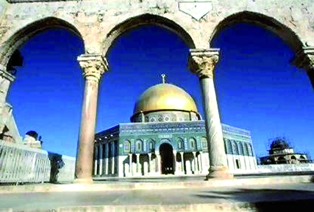
The event of the turning of the Qiblah (prayer direction) from Al-Masjid Al-Aqsa to the Ka‘bah was likely to be the decisive boundary between the two periods of the war of words and clashes and the actual interference of the Jews to destabilize the newborn Islamic state.
It was narrated on the authority of Al-Baraa’ bin ‘Aazib, may Allah be pleased with him, that he said,
When the prophet, , came to Madeenah, he stayed first with his grandfathers [or maternal uncles] from the Ansaar [helpers]. He offered his prayers facing Bayt Al-Maqdis [Jerusalem] for sixteen or seventeen months, but he wished that he could pray facing the Ka‘bah. The first prayer which he offered facing the Ka‘bah was the ‘Asr prayer in the company of some people. Then one of those who had offered that prayer with him came out and passed by some people in a mosque who were bowing during their prayer [facing Bayt Al-Maqdis]. He said addressing them, ‘By Allah, I testify that I prayed with the Messenger of Allah facing Makkah [the Ka‘bah].’ Upon hearing this, these people changed their direction towards the Ka‘bah immediately. The Jews and the People of the Book were pleased to see the Prophet, , facing Bayt Al-Maqdis in prayers, but when he changed his direction towards the Ka‘bah, during the prayers, they disapproved of it. [Al-Bukhari]
In connection with this event, great verses were revealed that teach many lessons, wisdom and benefits for Muslims. Allah The Almighty Says (what means): {So from wherever you go out [for prayer, O Muhammad] turn your face toward Al-Masjid Al-Haraam, and indeed, it is the truth from your Lord. And Allah is not unaware of what you do. And from wherever you go out [for prayer], turn your face toward Al-Masjid Al-Haraam. And wherever you [believers] may be, turn your faces toward it in order that the people will not have any argument against you, except for those of them who commit wrong; so fear them not but fear Me. And [it is] so I may complete My favor upon you and that you may be guided. Just as We have sent among you a messenger from yourselves reciting to you Our verses and purifying you and teaching you the Book and wisdom and teaching you that which you did not know. So remember Me; I will remember you. And be grateful to Me and do not deny Me.} [Quran 2:149-152]
a) Allah The Almighty revealed verses about the doubts and questions that the Jews would raise on changing the Qiblah from Bayt Al-Maqdis to the Ka‘bah, and this was before that event took place. That is a clear indication of the Prophethood of Muhammad, , for he disclosed one of the matters of the unseen before it occurred. It provides proof of the fact that Muhammad, was a Messenger and Prophet who knew from revelation things that would occur. One of the proofs that support the truth of the message of the messenger is to foretell matters of the unseen which then come to pass, in confirmation of his prophecy.
It also signifies a solution for problems before they occur, so that the Muslims would get ready and prepare themselves to face and overcome them because the unexpected problem is more difficult to handle and causes confusion, unlike the case when they are told about it before it occurs, because this makes them rest assured and get accustomed and ready to face difficulties. In his commentary on this verse, Abu As-Su‘ood,  , said, “He informed them about the event before it occurred to prepare the souls to face what might harm them. The sudden occurrence of what is intolerable is harder on the soul, and the well-prepared reply refutes the claim of the contentious enemy in a better way.”
Furthermore, Allah The Almighty ascribed foolishness to the Jews because of their objection to changing the Qiblah, and their plotting against the Messenger of Allah, . Abu As-Su‘ood, , said, “The foolish are those who have small minds, which they [nevertheless] slight by turning away from meditation and resorting to imitation. It is said, according to many [linguists], that the foolish person is the faker and inventor of lies who intentionally tells lies. Others make state that it is the wrongful and ignorant. Whatever it might be, the foolish are the Jews.”
, said, “The foolish are those who have small minds, which they [nevertheless] slight by turning away from meditation and resorting to imitation. It is said, according to many [linguists], that the foolish person is the faker and inventor of lies who intentionally tells lies. Others make state that it is the wrongful and ignorant. Whatever it might be, the foolish are the Jews.”b) Allah The Almighty Says (what means): {And thus We have made you a just community that you will be witnesses over the people and the Messenger will be a witness over you. And We did not make the Qiblah which you used to face except that We might make evident who would follow the Messenger from who would turn back on his heels. And indeed, it is difficult except for those whom Allah has guided. And never would Allah have caused you to lose your faith. Indeed Allah is, to the people, Kind and Merciful.} [Quran 2:143]
The verse mentions that the prayer while facing Bayt Al-Maqdis was a trial, and that changing the Qiblah from Bayt Al-Maqdis towards the Ka‘bah was also a trial. In his commentary on this verse, Al-Baydhaawi, , said,
, said,{And We did not make your Qiblah to be Jerusalem except that We might make evident who would follow the Messenger from who would turn back on his heels} That is, except to test the people therewith, and learn who among them would follow you in offering prayer while facing it, and who would turn back from your religion and persist in the Qiblah of his forefathers, or to learn [and distinguish] those who would follow the Messenger of Allah, , from those who would not follow him, and what is contingent upon a transient occasion vanishes with its disappearance.
According to the former interpretation: We have not restored you back to the Qiblah which you first used to face during prayer [i.e. the Ka‘bah], except to know him who would remain constantly firm on Islam and who would turn back on his heels, because of his weak faith. At first, the prayer was offered while facing the Ka‘bah, then it was turned to Bayt Al-Maqdis, and then it was restored to the Ka‘bah.
There was no harm in this as long as it was done in compliance with the command of Allah The Creator. Thus, turning the direction in all states was an act of worship, and all that the people had to do was to comply with the Order of Allah The Almighty. The one who followed the Messenger of Allah, , and complied with his orders in regard to the Qiblah issue succeeded and passed the test, and whoever found it difficult upon himself to accept a Sharee‘ah-based ruling failed the test, and was given to destruction.
True faith makes one follow the commands of Allah The Almighty and His Messenger, , and behave in opposition to his whims and desires. Thus, the honorable Companions remained constantly firm and responded to the commands of Allah The Almighty and His Messenger, . It was narrated on the authority of Ibn ‘Umar, may Allah be pleased with him, that he said, “While the people were offering the Subh [Fajr] prayer in [the mosque of] Qubaa’, a man came to them and said, ‘Quranic verses were revealed to the Messenger of Allah, , tonight in which he was commanded to face the Ka‘bah [in prayer].’ They faced it accordingly. They were facing Ash-Shaam [in their prayer when that news reached them], thereupon they [turned and] faced it [i.e., the Ka‘bah during their prayer].”
c) Allah The Almighty Says (what means): {And thus We have made you a just community that you will be witnesses over the people and the Messenger will be a witness over you. And We did not make the Qiblah which you used to face except that We might make evident who would follow the Messenger from who would turn back on his heels. And indeed, it is difficult except for those whom Allah has guided. And never would Allah have caused you to lose your faith. Indeed Allah is, to the people, Kind and Merciful.} [Quran 2:143]
This noble verse shows how the believers cared about the benefits of their brothers, and loved goodness for them. When the verses that commanded the believers to change the Qiblah to the Ka‘bah were revealed, the believers wondered, out of pity, about the destiny of the worship of their brothers, who had died and they were still facing Bayt Al-Maqdis in their prayers. Allah The Almighty says that their prayers were accepted.
It was narrated on the authority of Ibn ‘Abbaas, may Allah be pleased with him, that he said, “When the Prophet, , was turned towards the Ka‘bah [in his prayer], they [the Companions] said, ‘O Messenger of Allah what about our brothers who died while they were still facing Bayt Al-Maqdis in their prayers?’” [Sunan At-Tirmithi] On this occasion, Allah The Almighty Revealed (what means): {And never would Allah have caused you to lose your faith. Indeed Allah is, to the people, Kind and Merciful.} [Quran 2:143] In this verse, Allah The Almighty shows that He is Kind and Merciful to all. Therewith, He comforted and reassured the hearts of the Muslims, which overflowed with satisfaction, confidence and certainty (of faith).
d) Allah The Almighty Says (what means):
{We have certainly seen the turning of your face, [O Muhammad], toward the heaven, and We will surely turn you to a Qiblah with which you will be pleased. So turn your face toward Al-Masjid Al-Haraam. And wherever you [believers] are, turn your faces toward it [in prayer]. Indeed, those who have been given the Scripture well know that it is the truth from their Lord. And Allah is not unaware of what they do. And if you brought to those who were given the Scripture every sign, they would not follow your Qiblah. Nor will you be a follower of their Qiblah. Nor would they be followers of one another's Qiblah. So if you were to follow their desires after what has come to you of knowledge, indeed, you would then be among the wrongdoers. Those to whom We gave the Scripture know him as they know their own sons. But indeed, a party of them conceal the truth while they know [it]. The truth is from your Lord, so never be among the doubters. For each [religious following] is a direction toward which it faces. So race to [all that is] good. Wherever you may be, Allah will bring you forth [for judgment] all together. Indeed, Allah is over all things competent.} [Quran 2:144-148]
The Messenger of Allah, , was eager to turn his face in his prayer towards the Ka‘bah of Ibraaheem (Abraham), his father, may Allah exalt his mention. He, from among all the people, was the closest to him, for the Prophet, , was the fruit of his (Ibraaheem’s) invocation, and the true carrier of the flag of Tawheed (monotheism) which Ibraaheem, may Allah exalt his mention, had carried.
Furthermore, the Messenger of Allah, , was eager to be independent and distinguished from the people of the previous religions, like the Jews and Christians, who distorted, perverted and changed their religions. Hence, he forbade the Muslims from imitating them or copying their conduct. Thus, he commanded the Muslims to behave in opposition to them in terms of their deeds, and warned them of falling into the same mistakes and deviance in which they had fallen. Such keenness required that he should constantly turn his face in his prayer to the Qiblah of the father of the Prophets, (i.e. the Ka‘bah), which was the first Masjid (mosque) to be placed for the people on earth.
The event of turning the Qiblah (from Bayt Al-Maqdis to the Ka‘bah) had political, military, religious and historical dimensions. Politically, it brought back the Arabian Peninsula to take its place as the central axis of all events and incidents. Historically, it linked that world with the Arab heritage of Ibraaheem, may Allah exalt his mention. Militarily, it paved the way for conquering Makkah and putting an end to those odd conditions that surrounded Al-Masjid Al-Haraam, the centre of Tawheed, which had turned into a centre of idolatry. Religiously, it joined the hearts with the true religion and distinguished the Islamic nation from all other nations, and Islamic worship from the worship of all the other religions.

 Most View








 Home
 Discover Islam
 Quran Recitations
 Lectures
 Fatwa
 Articles
 Fiqh
 E-Books
 Women
 Boys & Girls